
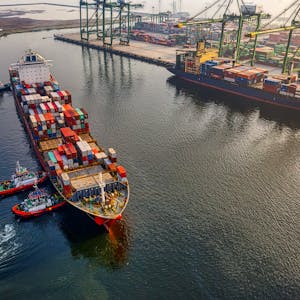
Charting the Course of Civilization: The Transformational Journey of Logistics
From the cobbled streets of ancient trade hubs to the seamless digital channels of e-commerce, the
logistical landscape has undergone a monumental transformation, shaping the course of human
progress. In the latest exploration on our Real Logistics blog, we delve into the historical
evolution of logistics—a journey not just crucial for the movement and management of goods but
pivotal in the rise and expansion of civilizations. As we chart this course, we unspool the
narrative that logistics is not merely about transportation; it's about the perpetual motion that
propels societies forward.
The Origins and Ancient Pioneers of Logistics
The concept of logistics, although having a military connotation that traces back to 17th-century
French military operations, is firmly rooted in ancient practices. To trace its essence, picture the
bustling ancient city of Varanasi in India, where trade thrived along the riverbanks. Like arteries,
trade routes such as the Silk Road and the waterways of Venice facilitated commerce and cultural
exchange, pulsing with life and livelihood.
Great leaders of yesteryears such as Alexander the Great and Hannibal were forerunners of strategic
transportation and supply chain management—without which their historic conquests would have been
stories left untold. These foundational practices were strikingly reminiscent of meticulous supply
chain models—like those seen in modern-day Mumbai's dabbawala network, known for their almost
error-free lunch delivery system.
The Growth of Cities and the Leap of Innovation
In the Middle Ages, the growth of logistics was synonymous with the growth of cities. The burgeoning
need for goods necessitated the development of sophisticated road networks, shipping lanes, and
warehouses—practices that resonate with the modern principles of efficient warehousing and
logistics.
Resilient and resourceful, historical hubs like Venice with its canals mirror today's dynamic cities
like Hamburg and Rotterdam—both vanguards in the European logistics scene. The spirit of the
Hanseatic League, a confederation that ruled Northern European trade, can be observed in modern
logistics alliances and partnerships that strengthen trade ties within Europe and beyond.
The Industrial Revolution: A Paradigm Shift in Logistics
The Industrial Revolution ignited a logistics renaissance, with railroads, steamships, and the
telegraph revolutionizing transportation and communication. Much like the European railway network
expansion or the majestic steamships that cut across oceans, contemporary logistics saw the advent
of air freight services, which compressed time and distance, turning the globe into an
interconnected village.
The Containerization Epoch and Its Global Impact
Yet, the industrial bravado of the 20th century brought with it a game-changing innovation:
containerization. Malcolm McLean's introduction of the uniform shipping container in the US paved
the way for standardized global trade—echoed in Europe's swift adoption that saw harbors like
Hamburg transform into central nodes in the international supply chain network. In parallel, India's
ambitious Golden Quadrilateral project emulates the drive for infrastructure that simplifies and
expedites domestic commerce.
The E-Commerce Revolution and the Logistical Shift
In modern times, we have witnessed a staggering shift in how logistics functions. The e-commerce
revolution, analogous to the timeless trade exchanges of yesteryears, has created an on-demand
economy that requires rapid fulfillment and last-mile delivery solutions.
Cities like London and Paris embody the cutting-edge of these transformations, with sophisticated
urban logistics solutions emerging to cater to the ever-increasing demands of online shoppers.
Similarly, in India, e-commerce giants are rewriting the playbook on logistics and distribution,
ensuring that the delivery of goods is as seamless as the click that initiates the purchase.
The Future: A Synthesis of Innovation and Efficiency
The future of logistics beckons with advancements that were once fodder for science fiction. From
autonomous electric trucks rolling on German autobahns to artificial intelligence orchestrating the
intricate dance of global supply chains, the sector is a testament to human innovation.
Seaports like Rotterdam are embracing the potential of smart technologies, integrating Artificial
Intelligence (AI) and the Internet of Things (IoT) to heighten efficiency and sustainability. The
drive toward automated, interconnected systems mirrors society's broader aims—where technological
empowerment meets sustainability goals.
The Unseen Engine Driving Progress
Our journey from ancient caravans to contemporary cloud computing, showcases logistics as the unsung
hero of human accomplishment. Recognizing logistics as the unseen engine driving progress is to
acknowledge the field's central in our past and future successes.
Conclusion: The Continuing Saga of Logistics
Our journey from ancient caravans to contemporary cloud computing, showcases logistics as the unsung
hero of human accomplishment. Recognizing logistics as the unseen engine driving progress is to
acknowledge the field's central in our past and future successes.
Real Logistics is committed to bringing attention to this crucial sector, weaving the story of
logistics as an epic tale of human innovation and adaptability. As logisticians, supply chain
professionals, and consumers, our lives are interwoven in this grand narrative. Join us as we
continue to explore the dimensions of logistics that keep the wheel of civilization turning.
In times to come, we will delve deeper into the advancements that paint the future of logistics.
Stay tuned to our blog to unravel the next chapter in this unfolding story of progress, efficiency,
and innovation.